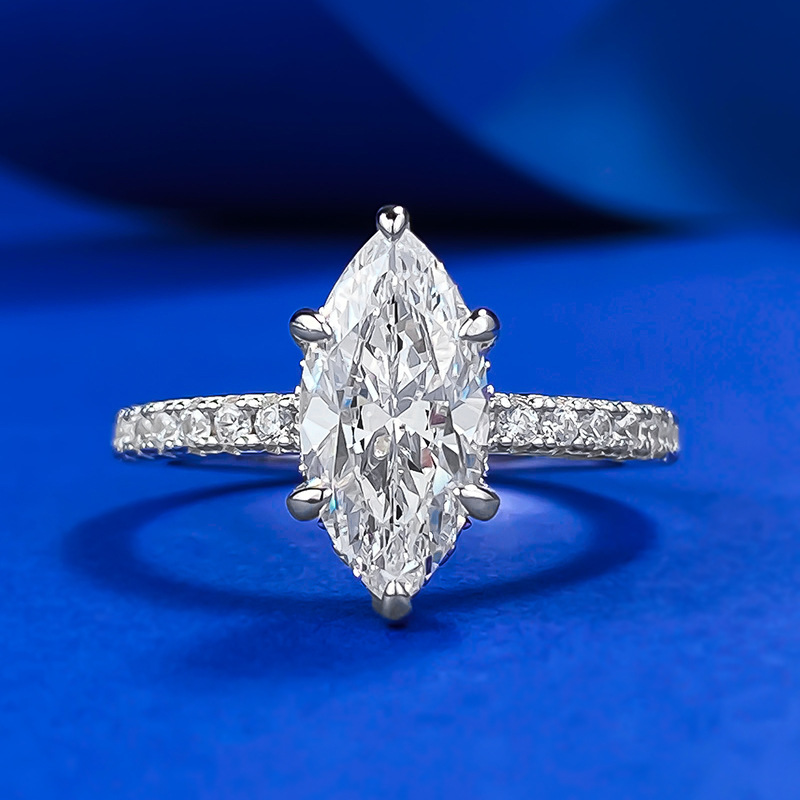
Marquise Cut Lab Diamond Wedding Band Pairing Guide
A Marquise Cut Lab Diamond wedding band pairing guide starts with fit, not trends. This diamond shape is graceful and bold, but its pointed tips and long outline can make band pairing tricky.
A straight band may sit flush, leave a clean gap, or press into the basket. A curved band may solve the fit, but it may not look as natural when worn alone. The best choice protects your ring, flatters the center stone, and feels good on your hand.
Why does this matter? A wedding band is worn every day, through morning coffee, work meetings, weekend errands, and all the small moments that make a marriage feel real. Tiny fit issues can turn into visible wear over time.
Why Marquise Lab Diamond Wedding Band Pairing Needs Extra Care
A marquise diamond has a long north-south shape with two pointed ends. That shape creates strong finger coverage and a slimming effect, but it also changes how a wedding band sits beside the ring.
Round and cushion diamonds often leave more predictable space near the base of the center stone. A marquise ring can have a low basket, V-prongs, a hidden halo, or a wider belly that blocks a straight band by just 1 or 2 millimeters.
Those small measurements matter. If a band rubs against prongs, pavé, a halo, or the gallery, it can wear down metal or loosen accent stones. If the wedding band sits too high, it can knock against the engagement ring each time your hand moves.
I've helped hundreds of couples choose marquise engagement rings and wedding bands, and the pairing that looks best on paper is not always the one that feels best on the hand. The side profile tells the truth every time.
A good marquise cut lab Diamond Wedding Band pairing guide should answer four questions:
- Do you want a flush fit, a small gap, a curved fit, or a stack?
- Does your engagement ring setting allow a straight band to sit beside it?
- What band width keeps the marquise as the main focus?
- Which metal and setting style match your daily routine?
A bridal set does not need perfect symmetry. A small, even gap can look modern. A chevron band can frame the lower tip. A plain gold band can make the marquise shape look crisp and sculptural.
If you are comparing rings online, use this marquise cut lab Diamond Wedding Band pairing guide with side-view photos, measurements, and expert advice. Fit comes first. Style follows.
Know Your Marquise Cut Lab Diamond Before Choosing a Band
The marquise cut has an elongated outline often described as boat-shaped. On the hand, it can make the finger look longer and the diamond appear larger face-up than some cuts of the same carat weight.
Lab-grown diamonds have the same optical, chemical, and physical properties as mined diamonds. They are crystallized carbon and are graded by the same core 4Cs: cut, color, clarity, and carat weight.
GIA and IGI both grade lab diamonds using detailed reports that may include measurements, polish, symmetry, clarity features, and growth method. That data helps you compare diamonds with more confidence before you choose a wedding band.
Marquise diamonds need special attention because the tips are more delicate than rounded edges. V-prongs or protective end settings help guard those points. Your wedding band should not push against that protection.
Shape Details That Affect Band Pairing
Length-to-width ratio changes the whole look of the bridal set. Many marquise diamonds fall near a 1.75:1 to 2.25:1 ratio, though personal taste matters. A slim marquise often looks best with a delicate band. A wider marquise can carry a slightly bolder style.
Orientation matters too. Most marquise engagement rings are set north-south, with one point facing the fingertip and one facing the wrist. The lower point is usually the area that creates a gap with a straight band.
A bow-tie may also affect the design mood. This shadow pattern appears in many elongated cuts, including marquise, oval, and pear shapes. A very bright marquise may look best with a simple band, while a softer antique-style stone may pair well with milgrain or baguette accents.
Setting Details That Affect Band Fit
The setting often matters more than the diamond shape. A high solitaire gives a straight band more room. A low basket may block a straight band completely.
Hidden halos, decorative galleries, bezel walls, and three-stone designs can also change the fit. These details may look small from the top, but they can control whether a band sits flush.
| Engagement Ring Setting | Band Fit Tendency | Best Pairing Options |
|---|---|---|
| High solitaire | Often allows straight bands | Plain, pavé, channel, half-eternity |
| Low solitaire | May create a gap | Curved, notched, chevron, custom contour |
| Cathedral | Depends on arch height | Straight if raised, contoured if blocked |
| Hidden halo | Often needs spacing | Curved, open, or custom band |
| Bezel | Can sit wider at the base | Plain contour or low-profile band |
| Three-stone | Side stones affect clearance | Custom, curved, or slim straight band |
| Vintage-inspired | Details may block flush fit | Milgrain contour, engraved band, custom match |
Before buying online, check side photos and millimeter measurements. StoneBridge Jewelry shoppers can also contact our jewelry experts for help with ring profile and band compatibility.
Marquise Cut Lab Diamond Wedding Band Pairing Guide: Fit Rules
The center of any Marquise Cut Lab Diamond wedding band pairing guide is practical fit. A band can look perfect in a photo and still be wrong for your ring if it rubs, twists, or overpowers the center stone.
Start with the relationship you want between the two rings:
- Flush fit: The band sits directly against the engagement ring.
- Intentional gap: The band leaves a small, even space.
- Contoured fit: The band curves or notches around the setting.
- Stacked look: The band becomes part of a layered set.
Next, think about scale. A 1.00 carat marquise on a 1.7 mm shank needs a different band than a 3.00 carat marquise on a 2.2 mm shank. Delicate bands from 1.5 mm to 2.0 mm often keep the shape elegant. Bands from 2.2 mm to 3.0 mm add more presence.
Metal also shapes the look. Matching platinum with platinum or yellow gold with yellow gold creates a clean bridal set. Mixed metals can work beautifully if they repeat a clear design idea.
Flush Fit or Intentional Gap?
A flush fit works best when the marquise is set high enough for the wedding band to pass beside or beneath the basket. High solitaires and settings designed with matching bands usually offer the easiest fit.
Do not force a flush set. If the lower point, halo, V-prong, or basket blocks the band, pressure can cause wear. A small gap is often the smarter choice.
A gap looks best when it is even. A slim plain band with clean spacing can feel intentional and modern. A band that almost fits but hits one side unevenly usually looks less polished.
Honestly, I think a tiny, intentional gap gets unfairly criticized. When it is even and balanced, it can look chic, relaxed, and very current. One of the most useful lessons in this marquise cut Lab Diamond Wedding Band Pairing guide is simple: a gap is not a flaw if it protects the ring.
Band Width, Diamond Size, and Finger Coverage
The marquise cut already gives strong finger coverage because of its length. A delicate wedding band keeps that long line clear, especially for center stones under about 1.50 carats.
Wider bands add style and weight. They can make a bridal set feel more fashion-forward, but they can also compete with a smaller center stone. If the band has large diamonds, the eye may leave the marquise first.
A helpful width range is:
- 1.5 mm to 1.8 mm for a delicate look
- 1.9 mm to 2.3 mm for classic bridal balance
- 2.4 mm to 3.0 mm for stronger presence
- 3.0 mm and above for statement stacks or larger center stones
Ring size also matters. A 3 mm band feels wider on a size 4.5 finger than it does on a size 8 finger. Comfort-fit interiors and softened edges can make daily wear easier (yes, even if you love a bold look).
Metal Matching and Mixed Metals
Matching metal is the most classic choice. Platinum with platinum feels cool and refined. Yellow gold looks warm and timeless. Rose gold softens the marquise shape. White gold gives a bright look, though it usually needs rhodium replating over time.
Mixed metals can look fresh when they feel planned. A yellow gold marquise ring can pair with a white gold diamond band if the white metal repeats the brightness of the lab diamond. A platinum solitaire can look striking with a slim yellow gold band.
Think about care, too. Platinum develops a patina. Gold shows wear differently by karat and color. Rose gold contains copper, which gives it warmth and changes how the metal wears.
Best Wedding Band Styles for a Marquise Cut Lab Diamond
The best wedding bands for marquise engagement rings respect the stone's length, tip protection, and setting profile. Straight bands can be beautiful. Curved, chevron, and custom bands often solve fit issues for lower settings.
Use this marquise Cut Lab Diamond wedding band pairing guide as a starting point, then compare the exact measurements of your ring.
| Band Style | Best For | Watch For |
|---|---|---|
| Plain straight band | High solitaires, simple sets | Gap near the lower point |
| Pavé straight band | Classic sparkle | Accent stones rubbing prongs |
| Curved band | Low baskets, halos | Less flexible worn alone |
| Chevron band | Framing marquise tips | Sharp angles may feel bold |
| Half-eternity band | Comfort and resizing | Stones cover only the top portion |
| Full-eternity band | Continuous sparkle | Harder resizing and higher cost |
| Custom contour | Unusual settings | Less adaptable for future stacks |
Straight Wedding Bands
Straight wedding bands are timeless and easy to wear alone. They work best with marquise engagement rings that sit higher from the finger.
Plain metal bands are the most understated option. They keep attention on the lab diamond and usually need less upkeep than diamond-accent bands. Pavé bands add sparkle, while channel-set bands create a smoother surface.
If a straight band leaves a gap, make the gap look planned. Choose an even space and a band width that feels balanced. Avoid a style that looks like it was meant to sit flush but missed.
Curved, Contoured, and Chevron Bands
Curved and contoured bands often pair well with marquise rings. They follow the setting shape, soften spacing, and frame the center stone.
Chevron bands create a V shape that echoes the pointed tip of the marquise diamond. A plain chevron looks clean and architectural. A diamond chevron adds sparkle while drawing the eye back to the center stone.
The challenge is alignment. A generic curved band may not match your basket width, stone length, or prong placement. If you want a close nest, custom or semi-custom shaping may be best.
Diamond-Accent, Eternity, and Anniversary Bands
Diamond-accent bands add shine and texture. Scale is the key. Small pavé diamonds can support a marquise center stone without taking over. Baguette accents create an Art Deco feel.
Half-eternity bands place diamonds across the visible top of the ring. They are often easier to resize and more comfortable than full-eternity bands. Full-eternity bands offer sparkle all the way around, but they cost more and are harder to size later.
In my years at StoneBridge, I have noticed that couples often choose a simpler wedding band when the engagement ring already has pavé, a hidden halo, or side stones. It is not because they want less sparkle. They want the whole set to breathe.
How to Choose a Band for Your Marquise Engagement Ring
A useful marquise cut lab Diamond Wedding Band pairing guide should give you a clear process. Start with the ring you have, not only the ring style you saved online.
Follow these steps:
- View the engagement ring from the side.
- Check whether the basket, halo, or prongs extend past the shank.
- Confirm the center stone length, shank width, and gallery clearance.
- Choose flush, gap, contour, or stack styling.
- Pick a band width that fits the center stone's scale.
- Compare metal color and maintenance.
- Test comfort with daily hand movement.
Lifestyle should guide the final call. If you work with your hands, lift weights, travel often, or want low care, a plain or channel-set band may suit you better than a tall shared-prong eternity band.
If you are still choosing the engagement ring, compare settings in StoneBridge Jewelry engagement rings with band fit in mind. You can also browse lab-grown diamonds and review certificates, measurements, and ratios before pairing the band.
Step 1: Check the Ring Profile
Look at the ring from the side. Does the center stone sit high above the finger, or does the basket sit close to the shank? A high setting usually gives a straight band more room.
Check the under-gallery. Hidden halos, scrollwork, and support bars can block flush stacking. V-prongs protect the marquise tips, but they may also create contact points.
If you shop online, ask for side-view images, videos, and millimeter measurements. A top-down photo can hide the exact issue that affects fit (trust me, I have seen it happen).
Step 2: Choose the Bridal Set Style
Your personal style changes the best band choice. A minimalist set may call for a slim plain band. A classic set may use pavé or a half-eternity style. A vintage-style marquise ring may pair well with milgrain, engraving, or baguettes.
A modern stack can use a chevron band, mixed metals, or a second anniversary band. Try this quick test: would you still like the wedding band without the engagement ring? Would the engagement ring still feel like the main piece without the band?
The best pairing passes both tests. It should feel beautiful on the wedding day and just as right years later when it catches the light while you are holding hands, carrying flowers, or opening a card from someone you love.
Step 3: Think About Comfort and Future Stacking
Band height affects comfort between the fingers. Tall diamond bands can feel bulky, especially with shared-prong or full-eternity settings. Low domed bands usually feel smoother.
Future stacking also matters. A deep contour or sharp chevron may fit one ring perfectly but limit later additions. If you want to add an anniversary band someday, choose a first band with a clean profile and manageable height.
Practical Buying Tips for Marquise Lab Diamond Wedding Bands
Online shopping works well when you Compare the Right details. Pretty photos help, but measurements protect you from a poor fit.
Before You Buy, check:
- Ring size and resizing limits
- Band width in millimeters
- Band height from finger to top surface
- Center stone length and width
- Setting height and basket clearance
- Accent diamond size and setting type
- Metal type and care needs
- Return, exchange, warranty, and resizing policies
Lab Diamond Bridal Sets benefit from exact specs. A 2.00 carat marquise lab diamond may measure about 13 mm by 6.5 mm, though proportions vary. A 1.00 carat marquise may measure near 10 mm by 5 mm. Those lengths affect how much of the band the center stone visually covers.
Price varies by metal, diamond coverage, setting labor, and total carat weight. Plain gold bands often cost less than diamond-accent or eternity designs. Full-eternity bands usually cost more because diamonds circle the entire ring.
For sizing help, review StoneBridge Jewelry's ring sizing guide. If you want to compare bands and fine jewelry styles, browse our jewelry collection or start a custom pairing through the ring builder.
Measurements to Know Before You Shop
Small differences matter. A 1 mm change in basket height can decide whether a straight band sits flush or hits the setting.
Gather these measurements:
- Center stone length and width
- Ring size
- Engagement ring shank width
- Setting height from finger to top of setting
- Basket width at the base
- Distance from lower basket to finger
- Wedding band width and height
- Accent diamond size, if choosing a diamond band
If you already own the ring, a jeweler can measure it with calipers. If you are buying both rings together, ask whether the engagement ring has a matching band or known compatible styles.
When a Custom Band Makes Sense
Custom contouring helps when the engagement ring has a low basket, unusual prong placement, a halo, side stones, or ornate details. A custom band can follow the exact shape of the marquise setting and reduce awkward gaps.
A matching band designed with the engagement ring usually gives the cleanest fit. It can align metal profile, diamond size, setting height, and curve.
The tradeoff is flexibility. A custom contour may not sit naturally with other rings, and it may look less balanced alone. If you plan to change your stack later, ask whether a semi-contoured or slim straight band could give you more options.
Common Mistakes in Marquise Cut Lab Diamond Wedding Band Pairing
The most common mistake is choosing a band from photos alone. A band may look perfect on a model hand and still fail beside your specific ring.
Another mistake is choosing a band that overpowers the center stone. A very wide band, large accent diamonds, or tall eternity profile can compete with the marquise outline.
Durability deserves the same attention as beauty. Rings that rub every day can wear down metal. Pavé and delicate prongs may need extra care if another band presses into them.
GIA diamond education often highlights symmetry, measurements, and setting protection for fancy shapes. For a marquise diamond, those details are especially useful because the pointed tips need smart protection.
Choosing Style Before Fit
A beautiful band can still be the wrong band. A straight full-eternity style may sit too tall against a low-set marquise basket. A deep chevron may frame the tip well but feel too sharp for daily wear.
Test comfort, alignment, and clearance before choosing the final look. If shopping online, compare side photos and return policies before committing.
Here's what nobody tells you: fit is not the boring part. Fit is what lets the style work. It is the quiet reason a bridal set feels effortless instead of fussy.
Overpowering the Marquise Shape
Marquise diamonds are loved for their long, elegant outline. A band that is too wide or heavily detailed can pull attention away from that shape.
Use scale to keep the center stone in charge. If the marquise is delicate, choose a delicate band. If the marquise is larger, a bolder band may feel balanced.
A statement band can work beautifully. The set just needs clear visual order, with the marquise as the lead piece.
Marquise Cut Lab Diamond Wedding Band Pairing Guide FAQs
What wedding band goes best with a marquise cut lab diamond engagement ring?
The best band depends on setting height, center stone size, and how you wear your jewelry. Straight bands work well with higher-set marquise rings. Curved, contoured, and chevron bands often suit low baskets or hidden halos. The right choice should feel secure, balanced, and comfortable.
Can a straight wedding band sit flush with a marquise cut diamond ring?
Yes, a straight band can sit flush if the marquise is set high enough and the basket does not block the band. High-profile solitaires give you the best chance. Low settings may need a gap, curve, or custom contour. If the band rubs the ring, choose protection over a forced flush fit.
Is a curved wedding band better for a marquise engagement ring?
A curved band is often better for a low-set marquise ring, but not always. It can frame the lower point and reduce uneven spacing. It may look less natural when worn alone, so try that look if solo wear matters to you. The best answer comes from your ring profile.
Should a marquise lab diamond wedding band be plain or diamond-accented?
Plain bands give a clean look and keep the center stone in focus. Diamond-accent bands add sparkle, but the accent size should match the scale of the marquise. If your engagement ring already has pavé, side stones, or a halo, a simple band may look more balanced. Choose the style you will enjoy wearing every day.
How do I know if I need a custom wedding band for my marquise ring?
You may need a custom band if your ring has a low basket, hidden halo, side stones, unusual prongs, or decorative gallery work. These details can stop a standard band from sitting comfortably. A jeweler can review side photos and measurements to confirm. Custom is best when exact fit matters more than future stack flexibility.
Building a Bridal Set That Feels Like Yours
The right band starts with fit, then moves into style. This marquise cut lab Diamond Wedding Band pairing guide can help you compare setting height, band shape, width, metal, comfort, and long-term Care Before You buy.
If your ring sits high, a straight band may look clean and timeless. If it sits low, a curved, chevron, notched, or custom contour may create a better fit. If you love sparkle, choose accent diamonds that support the marquise instead of competing with it.
There is room for personality. A small gap can look modern. Mixed metals can feel intentional. A plain band can look just as luxurious as an eternity band when the proportions are right.
Before you choose, compare real ring profiles, measurements, and band options. StoneBridge Jewelry can help you find a marquise lab Diamond Wedding Band that fits beautifully, wears well, and feels like yours.
Ready to Find Your Perfect Diamond?
Explore our collection of certified lab-grown diamonds
Shop Diamonds